














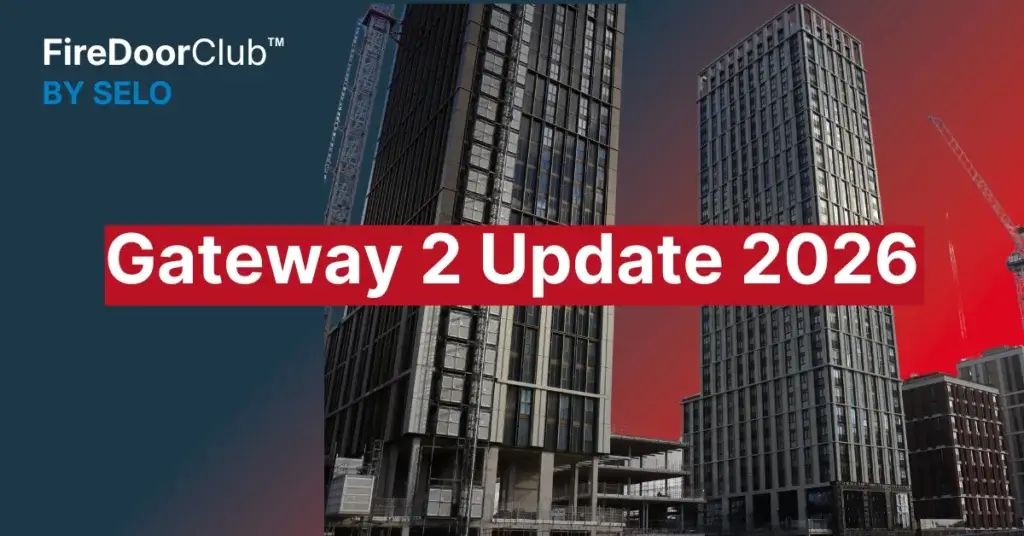
If you’re an architect, developer, or contractor working on a new project, you will be aware of Gateway 2 and the impact on approval for high-rise buildings. Since the launch of the Building Safety Regulator in 2022, approvals of high-rise buildings through Gateway 2 have been delayed.
In this blog, we are going to answer: ‘what is Gateway 2 and the Building Safety Regulator’, ‘what happened in 2025’, and provide a Gateway 2 update for 2026.
What is Gateway 2?
Gateway 2 is a mandatory stage for approval of buildings 18m+ or 7+ storeys that are deemed high-risk. The buildings require approval from the Building Safety Regulator before construction can begin, to ensure that building designs are compliant with fire safety and structural integrity.
Gateway 2 is the second of three mandatory checkpoints under the Building Safety Act 2022 for higher-risk buildings. The objective of Gateway 2 is to ensure safety is designed into high-rise, higher-risk buildings (HRBs) and generally has a 12-week statutory period to determine applications, although recently applications have taken longer than 12 weeks.
What is the Building Safety Regulator?
The Building Safety Regulator was created by the Building Safety Act 2022 to oversee the safety and performance of all buildings in England, with a specific focus on high-rise, high-risk residential buildings. The Building Safety Regulator approves the plans submitted at Gateway 2 to ensure safety-focused design plans and ensure the plans comply with building regulations.
What happened in 2025?
Gateway 2 faced criticism in 2025 due to a large share of applications being rejected due to missing or incomplete design, leading to delays. In addition, approvals took far longer than the target 12-week period, and many projects were stalled or required documentation to be re-submitted multiple times.
The Building Safety Regulator was previously a body established within the Health and Safety Executive. However, in June 2025, responsibility for the regulator was stripped from the Health and Safety Executive and handed to a new agency under the housing ministry. The changes were made to deliver a new fast-track process to speed up decisions.
Gateway 2 update 2026
So far in 2026, approval times have improved, with projects starting to fall near the 12-week target. It has been reported that some approvals were taking as long as 48 weeks and are now closer to 12-14 weeks. However, due to the number of applications increasing, there is still a large backlog of projects in Gateway 2 waiting for approval, with the majority of these projects in London.
The Building Safety Regulator has also undergone structural reforms, including process improvements and dedicated account managers, which has led to greater predictability throughout. Applicants now get feedback on incomplete submissions quickly to reduce delays.
Although the speed of application approvals and feedback has increased, there is still an emphasis on quality submissions and safety-led design.
Outlook
The Gateway 2 process will continue to become more efficient and bring approval times closer to the 12-week target. In addition, the backlog will shrink, with older applications that are stuck reducing and new projects moving through accordingly.
As a result, expect to see more Gateway 2 approvals in 2026, as the backlog clears, and new projects move through faster.
Conclusion
Since the Grenfell tragedy, projects going through Gateway 2 have faced the worst delays in years, but backlogs and delays to approvals are easing.
Gateway 2 still requires detailed design for building safety, fire compliance and abiding by building regulations. It is therefore important that those involved in the design and planning engage with the Building Safety Regulator early and display clarity in design.
In addition, although applications are moving through Gateway 2 more quickly, developers and designers should expect tighter scrutiny. Incomplete safety evidence will still lead to delays.
If you have any questions about Gateway 2 or specification support, please contact us on sales@selo.global or 020 3880 0339.